Sikh-Christian Fusion Wedding Florist
Anand karaj and Christian ceremony dual design for Sikh-Christian couples in California.
Sikh-Christian fusion weddings combine two ceremonial frameworks with different architectural and theological vocabularies. The anand karaj centers on the Guru Granth Sahib with reverent restraint; the Christian ceremony centers on the altar and officiant with liturgical structure. CHIC Flowers' Sikh-Christian fusion practice delivers designs that honor both ceremonies authentically while creating visual cohesion across the wedding day. This is one of the more technically demanding fusion pages we produce — thoughtful coordination with the granthi and Christian officiant is essential.
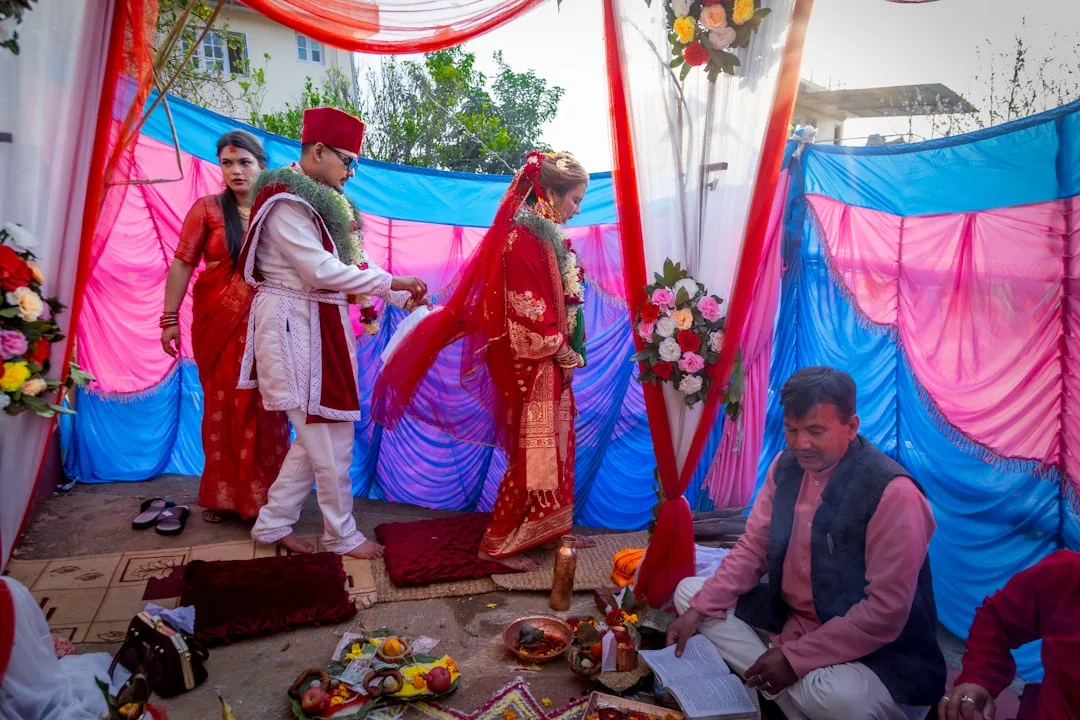
- ✻Separate architectural treatments for anand karaj palki and Christian altar
- ✻Unified white/ivory/champagne/gold palette across both ceremonies
- ✻Granthi + Christian officiant coordination on ritual overlap
- ✻Restrained saturated color per Sikh reverent tradition
- ✻Reception styling that continues unified visual vocabulary
Two ceremonies with distinct architectural languages
Sikh anand karaj uses an open-canopy palki structure centered on the Guru Granth Sahib. The couple circumambulates the palki four times during the lavan — an active, reverent ritual. Christian ceremony uses an altar or chuppah-style arch at the front of a seated congregation — the couple approaches the altar, exchanges vows, and remains stationary during the ritual moment.
Our fusion approach typically keeps the two ceremonies architecturally separate — the Sikh ceremony uses its palki design; the Christian ceremony uses altar or arch. Combining them into a single structure usually compromises both. The physical separation can be achieved in different rooms of the same venue, at different hours of the same day, or at different venues entirely.
Unified palette across both ceremonies
While architecture separates, palette unifies. Our Sikh-Christian fusion designs use a consistent palette across both ceremonies — typically white, ivory, champagne, gold, and soft pastels with occasional deeper accents. This palette honors Sikh reverence (white and gold are culturally appropriate for anand karaj) while providing the Christian ceremony with a familiar wedding-appropriate visual vocabulary.
Saturated warm palettes (crimson, marigold) typical of Hindu fusion weddings are less appropriate for Sikh-Christian fusion because they push away from Sikh reverent tradition. The restrained palette produces weddings that photograph editorially while remaining culturally authentic.
Officiant coordination
Sikh-Christian fusion requires two officiants — a granthi for the anand karaj and a Christian priest, pastor, or officiant. Our production coordination joins a three-way call with both officiants approximately three weeks before the wedding. Topics typically include ceremony timing, ritual element overlap (or deliberate separation), physical space coordination, and any shared moments the couple wants to incorporate.
Some couples request blended elements — the granthi offers a brief Sikh blessing at the Christian ceremony, or the Christian officiant speaks words during the anand karaj reception. These decisions require officiant pre-approval and careful pre-planning.
Reception styling
Reception after Sikh-Christian fusion ceremonies shifts to celebratory — full celebration scale typical of Sikh reception, with palette direction that continues the unified ceremony vocabulary rather than pivoting to saturated color. Our reception styling often incorporates cultural references (small floral elements nodding to Punjabi tradition, subtle palette accents) alongside contemporary fusion design.
Traditional Punjabi dance performance at the reception is common. Our reception design accommodates dance-performance floor space and staging while maintaining the unified aesthetic.
Begin the conversation
Share your dates, venue, and details — Alona reads every inquiry personally and responds within one business day.
Request a consultationExplore related design guides
Ceremony & design guides
Luxury venues we design
Serving these cities
Signature flowers
Planning & pricing