Sikh Wedding Florist — Anand Karaj
Open-canopy palki design and reverent floral styling for Sikh anand karaj ceremonies across California.
Sikh anand karaj ceremonies sit in a design category of their own. Unlike Hindu ceremonies centered on a fire mandap, Sikh weddings are centered on the Guru Granth Sahib — the sacred scripture placed on a raised palki (palanquin) at the front of the space. The couple circumambulates the palki four times during the lavan rather than sitting under a canopy. Our Sikh wedding floral design honors this by framing the Guru Granth Sahib with reverence and restraint rather than enclosing the couple in a dense canopy. CHIC Flowers has designed Sikh anand karaj ceremonies at gurdwaras, hotels, resort venues, and private estates across California.
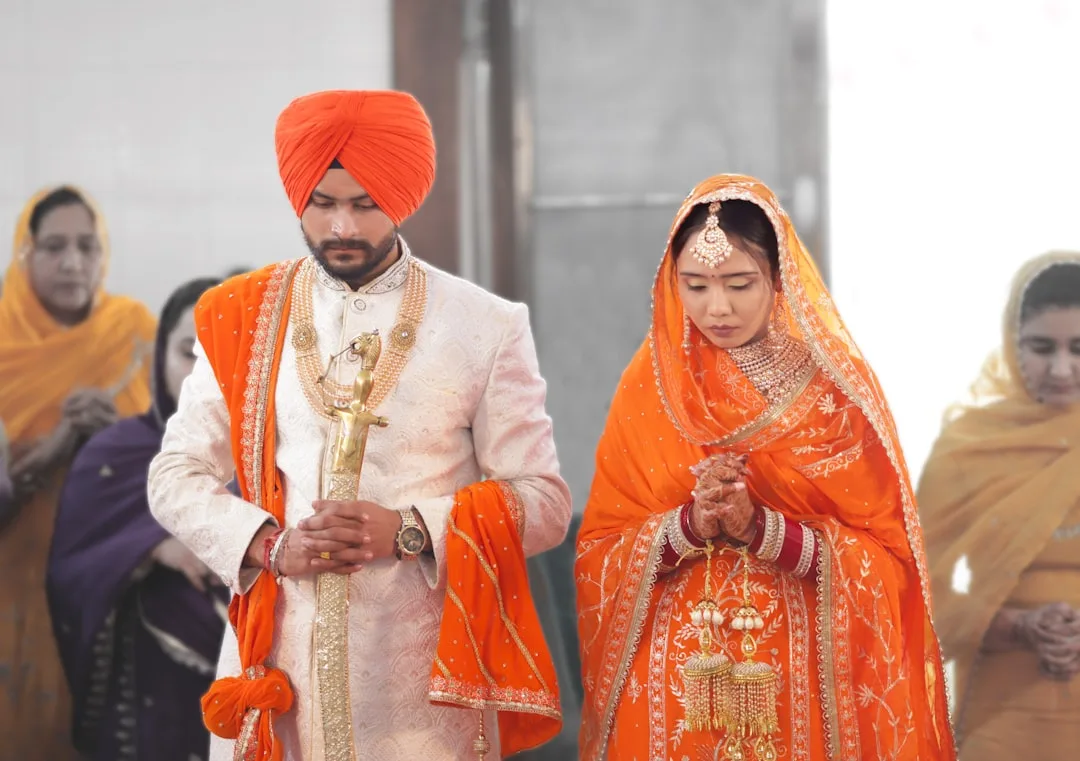
- ✻Open-canopy palki design for the Guru Granth Sahib
- ✻Reverent white, gold, and soft-pastel ceremony palette
- ✻Clear lavan circumambulation pathway engineered into every design
- ✻Direct coordination with granthi on ritual authenticity
- ✻Multi-day production across roka, mehndi, sangeet, anand karaj, reception
The palki and Guru Granth Sahib placement
The palki is the visual center of a Sikh anand karaj. Our design practice builds palki installations that elevate the Guru Granth Sahib with appropriate reverence — raised platform, framed by floral without covering it, with clean sightlines from every guest seat. The palki canopy above the Guru Granth Sahib is typically restrained, using white, gold, and soft pastels as the dominant palette. Dense saturated florals are avoided; the ceremony's visual vocabulary is one of reverence rather than celebration.
Palki positioning within the space determines guest seating and lavan pathway. We work with the granthi (the Sikh officiant who reads the Guru Granth Sahib) on palki orientation, which typically faces east or toward the designated direction per the gurdwara's tradition. Seat rows accommodate the couple's four circumambulations with a clear open pathway.
Lavan pathway and ceremony choreography
During the lavan — the four hymns sung from the Guru Granth Sahib — the couple circumambulates the palki once per hymn. Our ceremony design leaves a generous pathway clear of floral installation, tablescape elements, or any obstruction that might interrupt the lavan. Floral aisle runners are acceptable but should not raise above the ground level to avoid stepping complications.
Guest seating is typically arranged in sehra (carpet) format on the floor for traditional gurdwara ceremonies, or in chairs for hotel and resort ceremonies. For chair-based setups, we coordinate aisle widths with the planner to accommodate the couple's circumambulation.
Palette and aesthetic direction
Sikh anand karaj palettes lean white, gold, and soft pastels. Dense saturated color is avoided out of reverence for the Guru Granth Sahib. Our ceremony floral typically features white orchid, white rose, cream-toned lisianthus, gold-touched greenery, and restrained jasmine accents. Occasional deep red or saffron accents reference Sikh tradition but remain subordinate to the white-and-gold primary palette.
Reception after the anand karaj — which Sikh families call the party rather than the ceremony — is where celebration intensity increases. Our Sikh reception florals often shift to richer saturated palettes, Punjabi sangeet stage designs, and full floral coverage on par with a Hindu wedding reception. The palette difference between ceremony and reception is deliberate and carries cultural meaning.
Pre-ceremony events — anand karaj sequence
The Sikh wedding sequence typically includes roka (formal engagement), chunni chadhana (scarf ceremony at the bride's home), mehndi, sangeet, and the anand karaj itself. Our production covers the full sequence, with distinct design language per event. Mehndi and sangeet follow broadly similar aesthetic direction to Hindu counterparts. The anand karaj is where the design shifts to Sikh-specific reverence.
Doli and vidai (the bride's departure after the ceremony) are emotional moments that we design around with tasteful floral accents — typically a decorated car or palanquin with white and soft pastel floral — rather than dense celebratory installation.
Begin the conversation
Share your dates, venue, and details — Alona reads every inquiry personally and responds within one business day.
Request a consultationExplore related design guides
Ceremony & design guides
By tradition
Luxury venues we design
Serving these cities
Signature flowers
Planning & pricing