Phere Aisle Design (Saat Phere)
Ceremony aisle and circumambulation path design for Hindu wedding pheras.
The saat phere — the seven circumambulations the couple makes around the agni kund during a Hindu wedding — is the ritual heart of the ceremony. The physical path the couple walks during the pheras is a specific design consideration: it must stay clear of floral obstructions, accommodate the couple's tied garments and the officiating pandit, and read beautifully for photography and videography capture. CHIC Flowers designs phere aisle and walk-around paths with ritual-respecting clearance while incorporating culturally meaningful floral work that honors the moment.
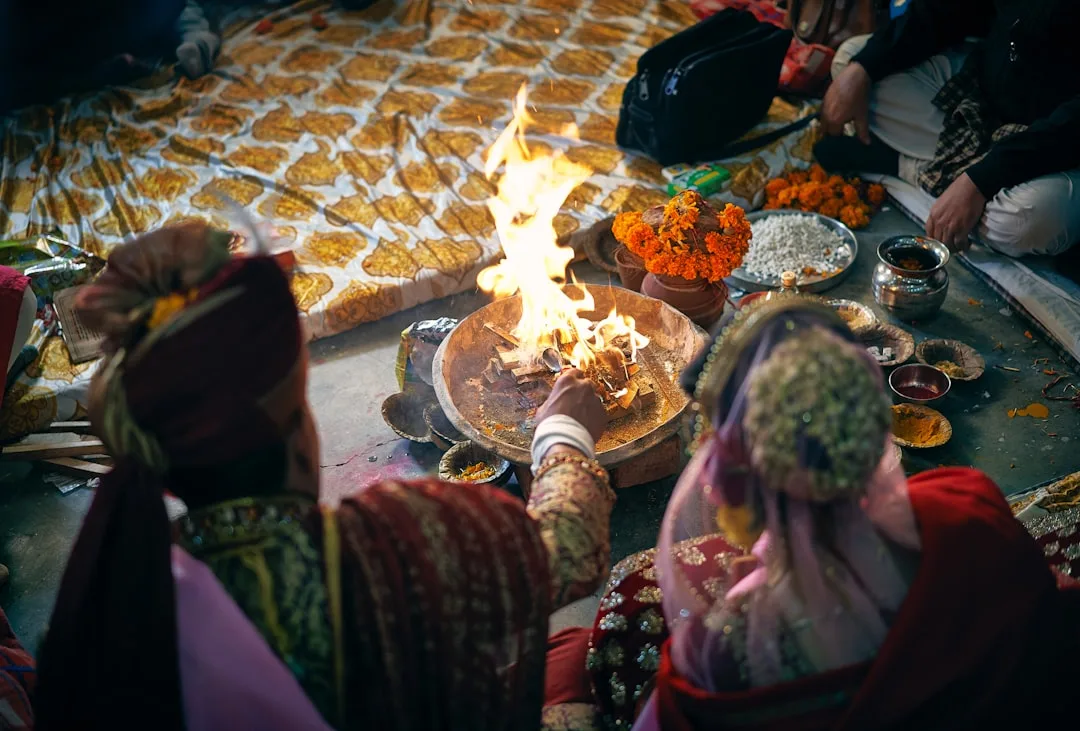
- ✻Clear walking path for active saat phere circumambulation ritual
- ✻Perimeter petal and cluster work without obstructing movement
- ✻Suspended floral above agni kund for visual drama without ground obstruction
- ✻Direct pandit coordination on clockwise/counterclockwise direction and count
- ✻Fusion-family accommodation for multi-tradition phere ritual
Why phere aisle design matters
The saat phere involves the couple walking seven times around the agni kund with specific vows recited at each circuit. This is an active, moving ritual moment — not a stationary one — and the physical path must accommodate continuous motion, the couple's ceremonial garments (which are tied together at key moments), the seated pandit, and clear sight lines for family photography. Dense floral work at ground level, elaborate runners that could catch feet, or any obstruction in the walking path undermines the ritual.
Our phere aisle design keeps the direct walking path clear while incorporating floral work at the perimeter of the circumambulation circle. Loose rose petals scattered around (but not in) the walking path, floral garlands marking the circle's outer edge, and small floral clusters at the pandit's seating position all read beautifully without interfering with movement.
Floral treatments that work
Scattered petal work at the perimeter is our default. Fresh rose petals in the ceremony's palette loosely scattered in a ring around the agni kund (outside the couple's actual walking path) mark the ritual space without obstructing movement. Petal density can range from light accent to dense carpet; we calibrate based on the palette and photography direction.
Small floral clusters at specific ritual points — the pandit's position, the kalash placement, the couple's starting position — add detail without density. These clusters are often small enough to be moved during the ceremony if needed.
Hanging floral work above the agni kund (suspended from the mandap canopy rather than sitting on the floor) can add dramatic visual weight without affecting the walking path. This works particularly well when the mandap canopy is designed to support suspended elements.
Coordinating with the pandit
The pandit determines the ritual specifics of the pheras, and we coordinate directly with the officiant on the walking path layout. Some pandits prefer the couple walk clockwise; others counterclockwise. Some traditions count seven circumambulations; some count four. Some include specific offerings into the agni kund at each circuit; some have the pandit alone manage the fire. These variations affect how we lay out the aisle, where we position floral elements, and where we stage the pandit's ritual items.
For multi-regional fusion families (Gujarati-Tamil, North-South Indian), the couple's families may have different phere traditions. We handle this by having the pandit-family conversation clarify which tradition will be followed, or by accommodating both traditions with extended ritual time and adjusted circumambulation counts.
Begin the conversation
Share your dates, venue, and details — Alona reads every inquiry personally and responds within one business day.
Request a consultationExplore related design guides
Ceremony & design guides
By tradition
Luxury venues we design
Serving these cities
Signature flowers
Planning & pricing