Hindu-Jewish Fusion Wedding Florist
Mandap and chuppah dual-ceremony design for Hindu-Jewish couples in California.
Hindu-Jewish fusion weddings blend two deeply meaningful religious traditions with distinct architectural languages — the mandap and the chuppah. CHIC Flowers' Hindu-Jewish fusion practice delivers designs that honor both traditions authentically: a traditional Hindu mandap with havan for the Hindu ceremony, a full chuppah structure for the Jewish ceremony, and reception styling that celebrates both heritages without compromising either. This is one of the richer fusion pages we produce, and thoughtful coordination with both the pandit and the rabbi is essential to getting the ceremony integration right.
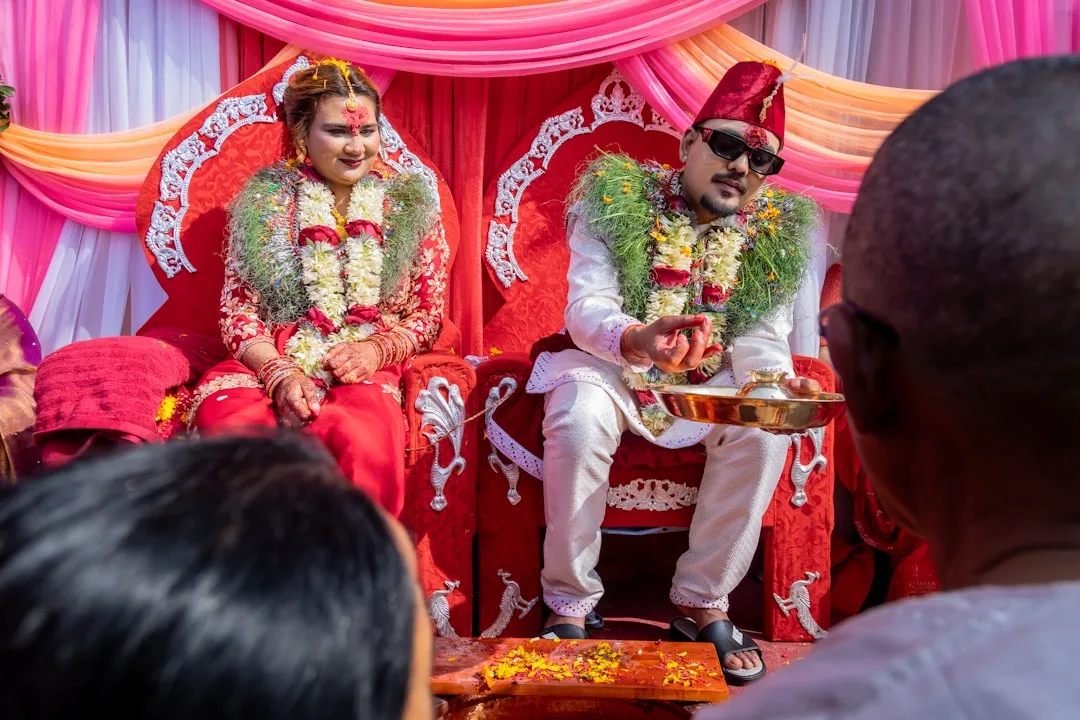
- ✻Separate or integrated mandap-chuppah structural approaches
- ✻Unified white/cream/gold palette with cultural anchor accents
- ✻Pandit + rabbi dual-officiant production coordination
- ✻Kosher + vegetarian catering presentation coordination
- ✻Shabbat-observance aware scheduling and installation timing
Mandap and chuppah — separate or integrated
Our Hindu-Jewish fusion practice supports two structural approaches. The first is separate structures — a full traditional four-pillar mandap with agni kund for the Hindu ceremony, and a full traditional chuppah for the Jewish ceremony, physically separate within the same room or at different hours or at different venues. This is the cleanest approach architecturally because each tradition gets its full visual language.
The second is an integrated single structure — a four-pillar frame that functions as mandap during the Hindu ceremony (dressed with marigold and rose, with agni kund at center) and as chuppah during the Jewish ceremony (re-dressed with softer floral, with ketubah signing table). Our in-house fabrication makes this integration possible in a way rental mandaps typically cannot.
Most fusion couples we work with choose separate structures when both families want full traditional presentation. Integrated structures work when both families prioritize visual simplicity over separate-tradition architectural density.
Unified palette across both ceremonies
Hindu-Jewish fusion palettes lean white, cream, champagne, soft gold, and restrained warm accents. This palette honors Jewish chuppah tradition (which favors refined restrained aesthetics) while accommodating Hindu cultural presence through selective marigold and rose accents at the mandap.
Saturated crimson and fuchsia Hindu palettes can feel visually disruptive against Jewish chuppah tradition. Our design conversations with Hindu-Jewish couples usually establish a unified restrained palette with cultural anchor accents rather than full saturated color.
Dual-officiant coordination
Hindu-Jewish fusion requires two officiants — a pandit for the Hindu ceremony and a rabbi for the Jewish ceremony. Our production coordination joins a three-way call with both officiants approximately three weeks before the wedding. Topics include ceremony timing, shared ritual moments (unity candle integration, shared blessing moments, combined ring exchange), physical space coordination, and cultural protocols each officiant requires.
Kosher and vegetarian catering often coexist at Hindu-Jewish fusion weddings. Our scope doesn't include catering, but we coordinate with the caterer on presentation styling so vegetarian and kosher stations read clearly and respectfully for all guests.
Shabbat considerations
Jewish families observe varying levels of Shabbat practice, and this affects wedding scheduling meaningfully. Saturday (Shabbat) weddings are restricted for observant Jewish families; most Hindu-Jewish fusion weddings with observant families happen on Sunday or weekday dates. Some Reform or Conservative families accept Saturday weddings after havdalah (sunset); others do not. This is a family-level conversation that your planner typically handles, but it shapes the wedding date decision and our installation schedule accordingly.
Begin the conversation
Share your dates, venue, and details — Alona reads every inquiry personally and responds within one business day.
Request a consultationExplore related design guides
Ceremony & design guides
Luxury venues we design
Serving these cities